Dishwasher Not Draining? The Checks I Do, In Order
By Mluleki Ndlovu · 2 October 2026
A dishwasher that will not drain is usually blocked, not broken. The most common cause is a clogged filter at the bottom of the tub, followed by debris in the sump or pump cover, a kinked drain hose, or a blocked sink trap that the dishwasher drains into. Switch off at the wall and check those in that order. If the water still will not go down, or the pump hums without draining, the drain pump or its control has likely failed and that needs a technician.
You open the door at the end of the cycle and there is dirty water lying in the bottom of the tub. The dishes are not properly clean, there is a smell, and the display may be flashing an error. Most of the time this is a blockage you can clear yourself without tools, and I would rather you try that before you pay for a call-out.
Is some water in the bottom of a dishwasher normal?
A little clear water sitting in the sump, the small well under the filter, is normal on most dishwashers. It keeps the seals from drying out between washes. What is not normal is water covering the floor of the tub, or cloudy water with bits of food in it after the cycle has finished.
Before you start pulling anything out, make sure the cycle actually finished. If someone opened the door mid-wash, or the power dropped, the machine may simply be paused with water still inside. Close the door and let it complete, or use the cancel or drain function your manual describes. If the water goes down, there is nothing wrong.
What a drain error code is telling you
Many dishwashers show a code when they cannot drain. On Bosch and Siemens it is usually E24 or E25. On Samsung it is 5C or SE. In plain terms, they all mean the same thing: the machine tried to pump the water out and could not get it out in time.
The code tells you the water did not leave. It does not tell you where it got stuck. That is what the checks below are for.
How does a dishwasher drain?
It helps to know the path the water takes, because a blockage anywhere along it gives you exactly the same symptom.
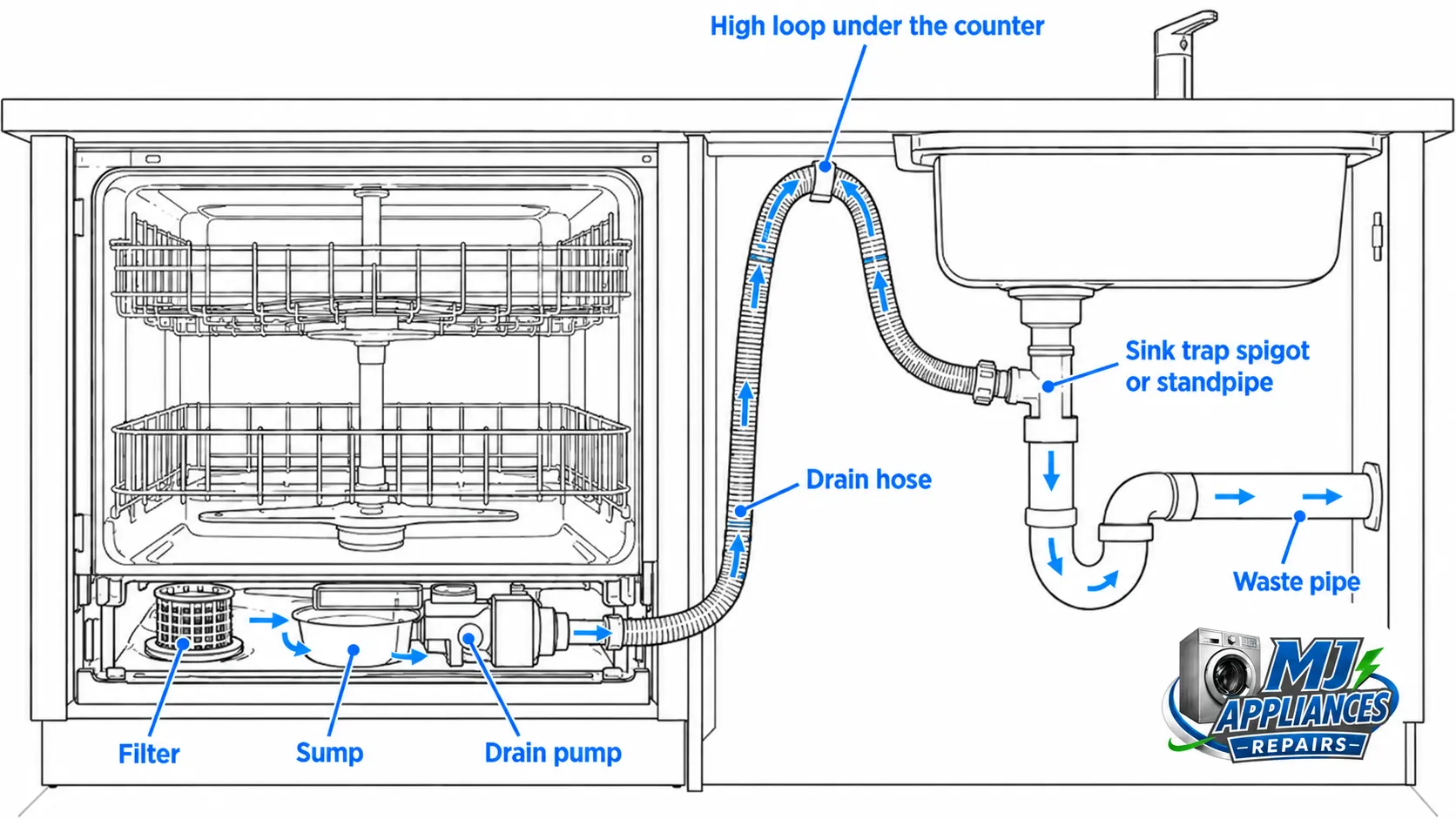
Water from the wash passes through the filter at the bottom of the tub and collects in the sump. The drain pump pushes it out through the drain hose at the back of the machine. That hose rises up under the counter in a loop, then drops into a spigot on the sink trap or into a standpipe, and from there into the house waste pipe.
So when I arrive at a dishwasher that will not drain, I do not start with the pump. I start with the filter and work outward along that path, easiest first. You can do the same.
The checks inside the dishwasher, in the order I do them
These are safe for any homeowner. Have a cup, a sponge, an old towel and a torch ready.
- Switch off at the wall and unplug the dishwasher. Never put your hands in the tub with the power on. The pump can start without warning.
- Bail out the standing water with the cup, then soak up the last of it with the sponge. Go slowly, because broken glass often ends up down here.
- Pull out the bottom rack and remove the filter. On most machines it twists anticlockwise and lifts out. Your manual will show the exact method for your model.
- Rinse the filter under a running tap and scrub it with a soft brush. Look for a grey film of grease as well as food. A filter can look clear and still be blocked by grease.
- Shine the torch into the sump and remove anything you can see by hand. Fruit pips, bits of glass, bottle labels and toothpicks are the usual finds.
- Check under the pump cover, if your machine has one. On many models, including Bosch and Siemens, there is a small cover in the sump that the manufacturer lets you prise off with a teaspoon to reach the pump impeller. Clear anything caught there and clip the cover back. If your manual does not show this cover, skip this step.
- Refit the filter firmly. Never run a dishwasher without its filter in place. Whatever gets past it goes straight into the pump.
If you found a blockage, there is a good chance you are done. Plug in, switch on, and run a short programme to confirm.
Is the problem actually under your sink?
This is the part most online guides miss, because most of them are written for American kitchens with a waste disposal unit. Most South African kitchens do not have one. Here, the dishwasher hose usually connects to a spigot on the sink trap, or shares a standpipe with the washing machine.
That matters, because a blocked sink trap will stop the dishwasher draining even when the dishwasher itself is perfectly fine.
- Keep the dishwasher switched off at the wall.
- Fill the sink and pull the plug. If the sink drains slowly as well, the blockage is in your plumbing, not the dishwasher. Clearing the trap or calling a plumber will fix both at once.
- Look at the drain hose under the sink. Check it is not kinked, crushed behind a bin, or pinched where the machine was pushed back into its space.
- Check that the hose rises in a high loop before it drops into the trap or standpipe. A hose lying low, or pushed too deep into a standpipe, can let dirty water siphon back into the dishwasher. The installation manual usually gives the correct height.
- Run a short programme and listen. You should hear the pump run and the water leave.
One honest warning. If your dishwasher is built in under the counter, do not drag it out to reach the hose. Integrated units are fixed to the cabinetry, and pulling one out can tear the inlet hose or damage the kitchen. That is a job for someone who does it regularly.
Why does it keep happening?
A dishwasher that blocks again and again is usually telling you about habits, not faults. Plates going in with food still on them, a filter that only gets cleaned when there is a problem, and greasy pans all push debris into the sump faster than the filter can cope.
Detergent is the other common cause. Using ordinary washing-up liquid, even a small squirt, makes far more foam than a dishwasher is built for, and foam stops the pump from moving water properly. Only use products made for dishwashers.
If you are on hard or borehole water, which is common in some Midrand estates, scale can also build up in the sump over time. A dishwasher cleaner and the correct salt setting help keep that under control.
When to stop and call a technician
Call someone once you have done the checks above and the water still will not go down, or if any of these is true. You can hear the pump humming but no water leaves, which usually means the pump is jammed or failing. You hear no pump at all when it should be draining. The error comes back straight away after you have cleared everything. Or there is water leaking from under the machine.
At that point the fault is in the drain pump, its wiring, or the control that tells it to run. That is technician territory. The pump is connected to the mains supply, and on most machines you have to tip the dishwasher or remove the base panel to reach it. If you have already started opening panels, stop there and tell your technician exactly what you removed. My post on a Bosch dishwasher soap dispenser not opening explains why that honesty saves you money.
I repair dishwashers across Midrand, and you can see what that covers on my dishwasher repair page or the full list of services. My call-out fee covers a proper on-site diagnosis and a full quote before any work starts. If you go ahead with the repair, the call-out fee comes off the total bill.
If your dishwasher is not draining, send me a WhatsApp on 082 419 4125 with the brand, any error code on the display, and which of the checks above you have already done. You can also book a visit here.