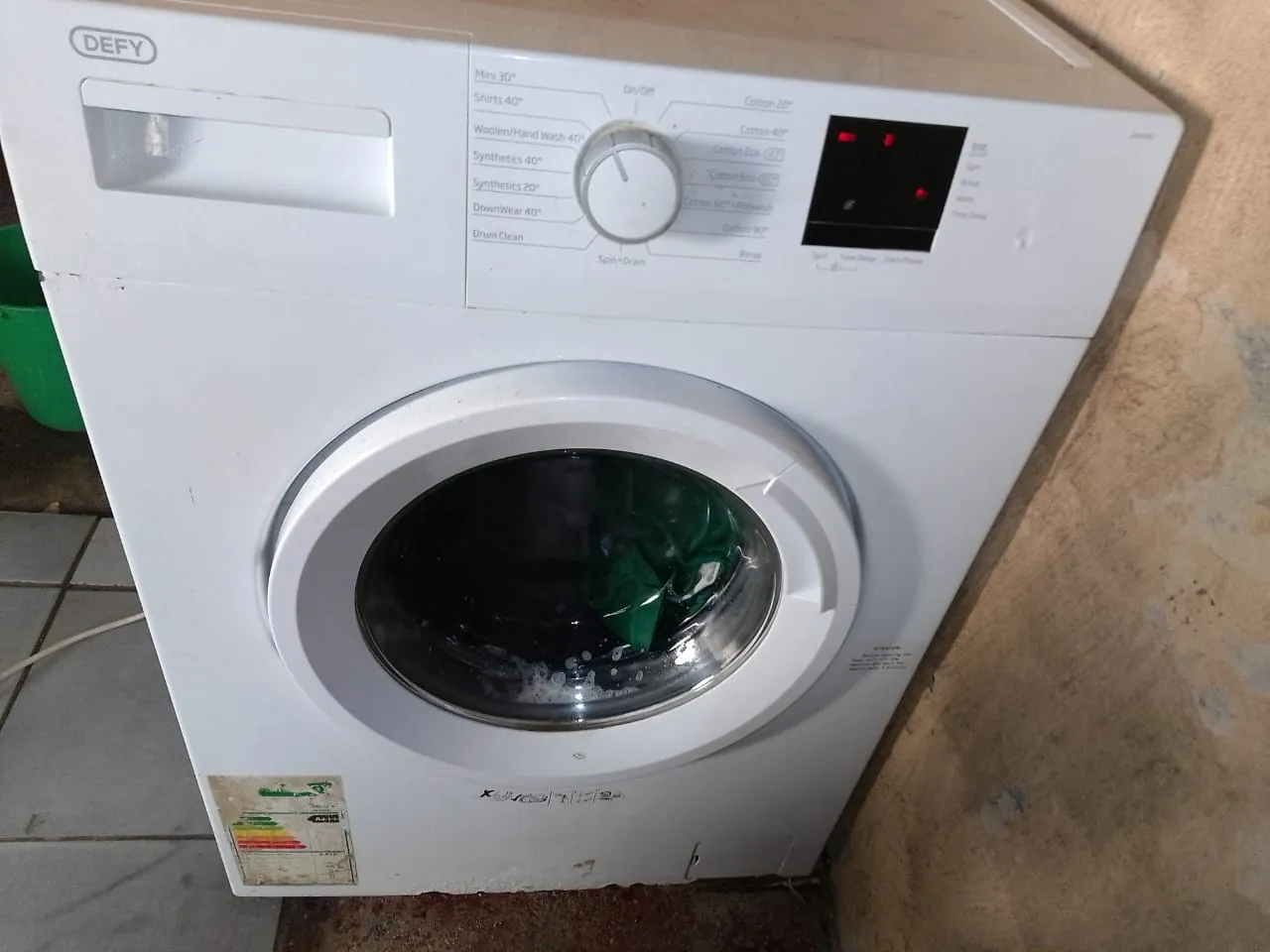
Washing Machine Won't Spin — The Six Faults, In The Order I Check Them
By Mluleki Ndlovu · 1 August 2026
A washing machine that won't spin is usually one of six things: an unbalanced load, a blocked drain, a faulty door lock, a slipped or broken drive belt, worn motor brushes, or a control board fault. The first two you can often sort out yourself in a few minutes. I check them in that order because that's roughly how common they are, and because a machine won't spin at all until it has finished draining.
A washing machine that fills, washes, and then just sits there with a drum full of wet clothes is the call I get more than any other. Almost everyone who phones me has already decided the motor is finished. Most of the time it isn't — and two of the six things I check cost nothing to fix.
Here is the order I work through when I arrive at a house in Midrand, and why that order matters.
Fault 1: The load is unbalanced
Every modern machine has a sensor that detects when the drum is loaded unevenly. If the weight is all on one side, the machine will refuse to build up to spin speed, because a drum spinning fast with an unbalanced load will destroy its own bearings. So the machine protects itself. It tries, gives up, tries again, and eventually stops with your washing still soaked.
This happens most with one heavy item on its own — a duvet, a blanket, a single pair of jeans, a bath mat. It also happens when clothes ball up inside a duvet cover during the wash.
How to check it:
- Switch the machine off at the wall before you open anything or put your hands in the drum.
- Open the door and look at how the washing is sitting. If it's all bunched on one side, or wrapped into one heavy rope, that's your answer.
- Pull the load apart by hand and spread it evenly around the drum. If it's a single heavy item, add two or three towels to balance the weight.
- Switch back on and run a spin cycle only.
If it spins, there was never a fault. This is the single most common reason I get called out to a machine that turns out to be fine.
Fault 2: The machine can't drain
This is the one worth knowing about, because it's the most common actual fault and it's often a customer fix.
A washing machine will not spin until it has emptied the water out of the drum. That is a safety interlock, not a fault. So if the pump can't clear the water, the machine simply never gets to the spin stage — and from the outside it looks like a spin problem when it's actually a drainage problem.
The usual culprit is the drain pump filter. It sits behind a small hatch at the bottom front of most front-loaders, and it catches coins, hair clips, screws, buttons, tissue, and bits of fluff. On a machine that's never been cleaned it can be packed solid.
How to check and clean it:
- Switch the machine off at the wall and pull the plug out. Don't skip this — you're about to open a compartment near the motor.
- Put an old towel and a shallow tray or baking dish on the floor in front of the machine. There will be water and there will be more of it than you expect.
- Open the small hatch at the bottom front. Some machines have a short drain hose tucked inside — pull it out, take the cap off, and let the water run into the tray first.
- Turn the filter cap anticlockwise slowly and let the rest of the water out before you pull it all the way free.
- Clean out everything you find — including the housing behind the filter. Feel inside gently for anything the filter missed.
- Screw the filter back in firmly, close the hatch, plug in, and run a spin cycle.
While you're there, check the drain hose at the back isn't kinked, crushed against a wall, or pushed too far down the outlet pipe. On top-loaders the filter is often less accessible or absent, and a blockage is usually in the pump itself — that one you'll want a technician for.
If the machine drains fine but still won't spin, we move on.
Fault 3: The door lock isn't confirming
A front-loader won't spin unless the door lock tells the control board the door is properly shut and latched. The lock is an electrical component, not just a catch. When it fails, the machine often still fills and washes but stops before the spin, sometimes with an error code.
You can check the simple part of this yourself: look at the latch on the door and the striker on the machine for anything obstructing them, and check the rubber door seal for a sock or a coin wedged in the fold. Push the door firmly shut and listen for the click.
If the click is absent, weak, or the machine reports a door error with the door plainly shut, the lock assembly has failed. Replacing it means getting into the front panel and disconnecting a live circuit, so that's a technician job.
Fault 4: The drive belt has slipped or come off
On belt-driven machines, a belt that has stretched, slipped off the pulley, or snapped gives a very distinctive symptom: you can hear the motor running normally, but the drum doesn't turn — or turns during the wash but never picks up spin speed. Sometimes there's a burning rubber smell.
The quick check is to switch the machine off at the wall, open the door, and turn the drum by hand. A machine with a healthy belt has noticeable resistance. If the drum spins freely and quietly with almost no drag, the belt has likely gone.
Fitting a new belt means removing the back panel and working around the motor. It's a straightforward repair for a technician and usually not an expensive one — but it isn't a job to do with the machine plugged in, and it isn't a job to do without the correct belt for that model.
Fault 5: The motor brushes are worn
Machines with brushed motors — common on older front-loaders — use two small carbon blocks that press against the motor to carry current. They wear down over years of use. When they get short, the motor still has enough power to turn the drum slowly during a wash but not enough to reach spin speed.
The signs are consistent: the machine washes normally, then makes a laboured noise when it tries to spin and never gets up to speed. Sometimes there's a faint burning smell or a crackling sound. Owners often describe it as the machine "trying but giving up."
Brushes are a wearing part and replacing them is routine work, but it means opening the machine and working directly on the motor. That's technician territory.
Fault 6: The control board or the speed sensor
The last thing I check is the electronics, because it's the least common cause and the most expensive assumption to make first. A failed speed sensor on the motor means the board can't tell how fast the drum is turning, so it won't commit to a spin. A damaged control board can fail in any number of ways, including refusing to spin.
In Midrand this matters more than it should, because of what our power supply does to appliances. Every time the power comes back after load shedding, it doesn't come back cleanly — there's a surge as the load reconnects. Control boards are the part that takes that damage. If your machine stopped spinning shortly after a power outage, or started throwing error codes it never used to, a surge is a reasonable suspicion.
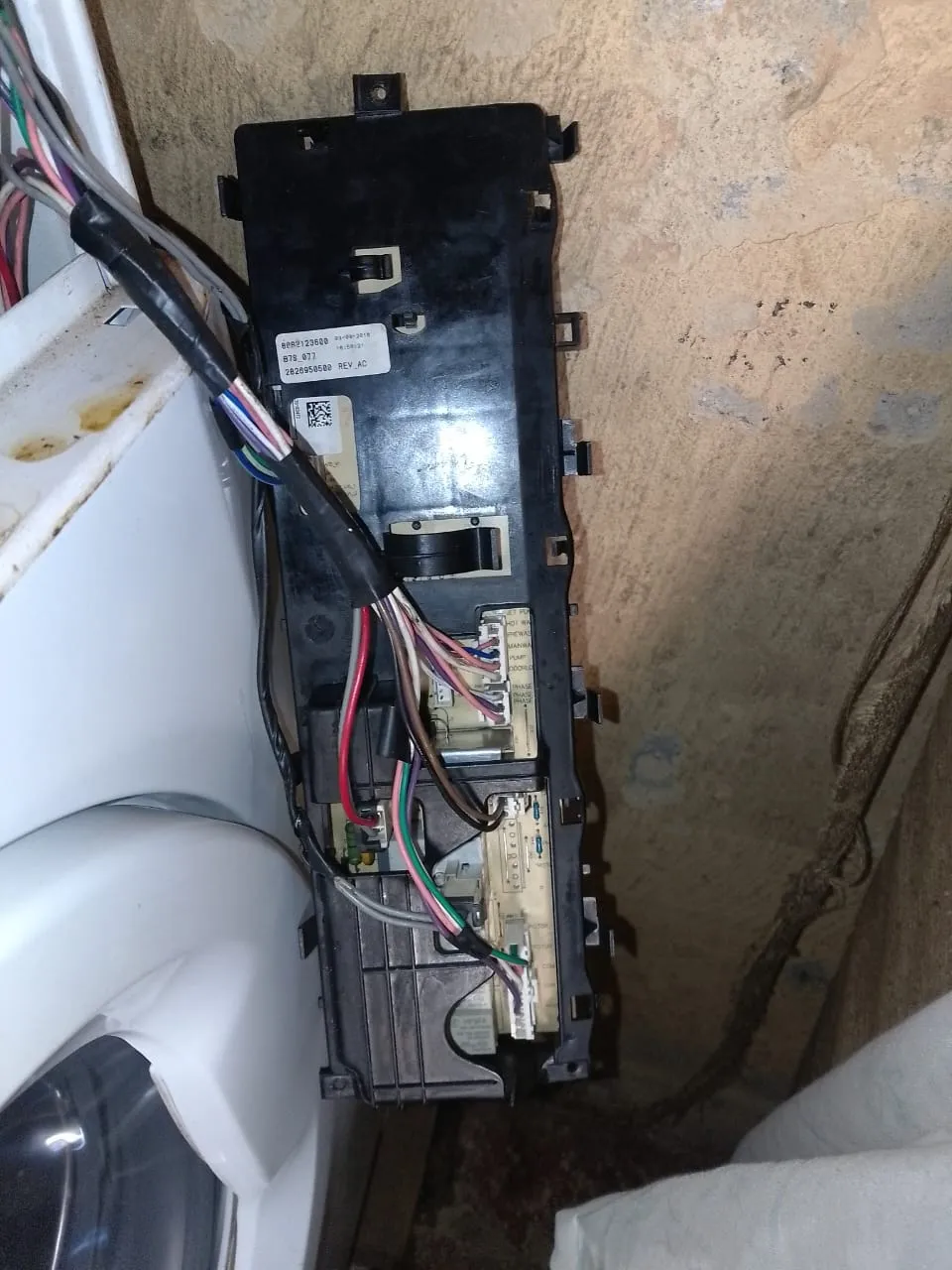
That is what sits behind the front panel — the board, the relays and the wiring loom that runs to the motor, the pump and the door lock. It is not a part anyone should be getting to at home, and it is the part you want properly diagnosed before you pay for it.
Two things worth knowing. First, plug the machine into a surge-protected socket or adaptor — it costs very little compared to a board. Second, don't accept a board replacement quote without a proper diagnosis. I've been called to machines that previous technicians all said needed a new control board, where the actual fault was somewhere else entirely. A board is the most expensive part in the machine and it's also the easiest one to blame.
If your machine is showing an error code, that's a shortcut worth taking before anything else — the code narrows the fault down considerably. I've written up what the codes mean on Defy machines here: Defy Washing Machine Error Codes Explained
When to stop and call a technician
Do these two yourself, always: rebalance the load, and clean the drain filter. Between them they account for a large share of the no-spin calls I go out to, and neither needs a tool or a technician.
Stop at the point where you'd need to open the machine. Behind the panels are mains wiring, a motor, and components that hold a charge even when the machine is unplugged. It isn't worth the risk, and a machine that's been partly dismantled is a longer, more expensive job for whoever finishes it.
Call someone when: the machine drains properly but still won't spin; the drum turns freely with no resistance; the motor labours and never reaches speed; the door won't confirm as locked; or an error code keeps coming back after a power cut.
When I come out, I diagnose the fault at your home and give you the full cost before I start anything. The call-out fee is R650, and if you accept the quote it comes off the repair cost. You decide whether to go ahead once you have the quote. Workmanship on repairs I complete is covered for three months — the details are on our repair warranty page.
You can see everything we repair on our services page, or get in touch through the contact page.
Still not spinning?
Send me a WhatsApp on 082 419 4125 and tell me three things: the make of the machine, whether it drains, and any error code on the display. That's usually enough for me to tell you what it likely is before I get there — and whether it's something you can sort out yourself.