Fridge Not Cooling? The Faults, In The Order I Check Them
By Mluleki Ndlovu · 16 October 2026
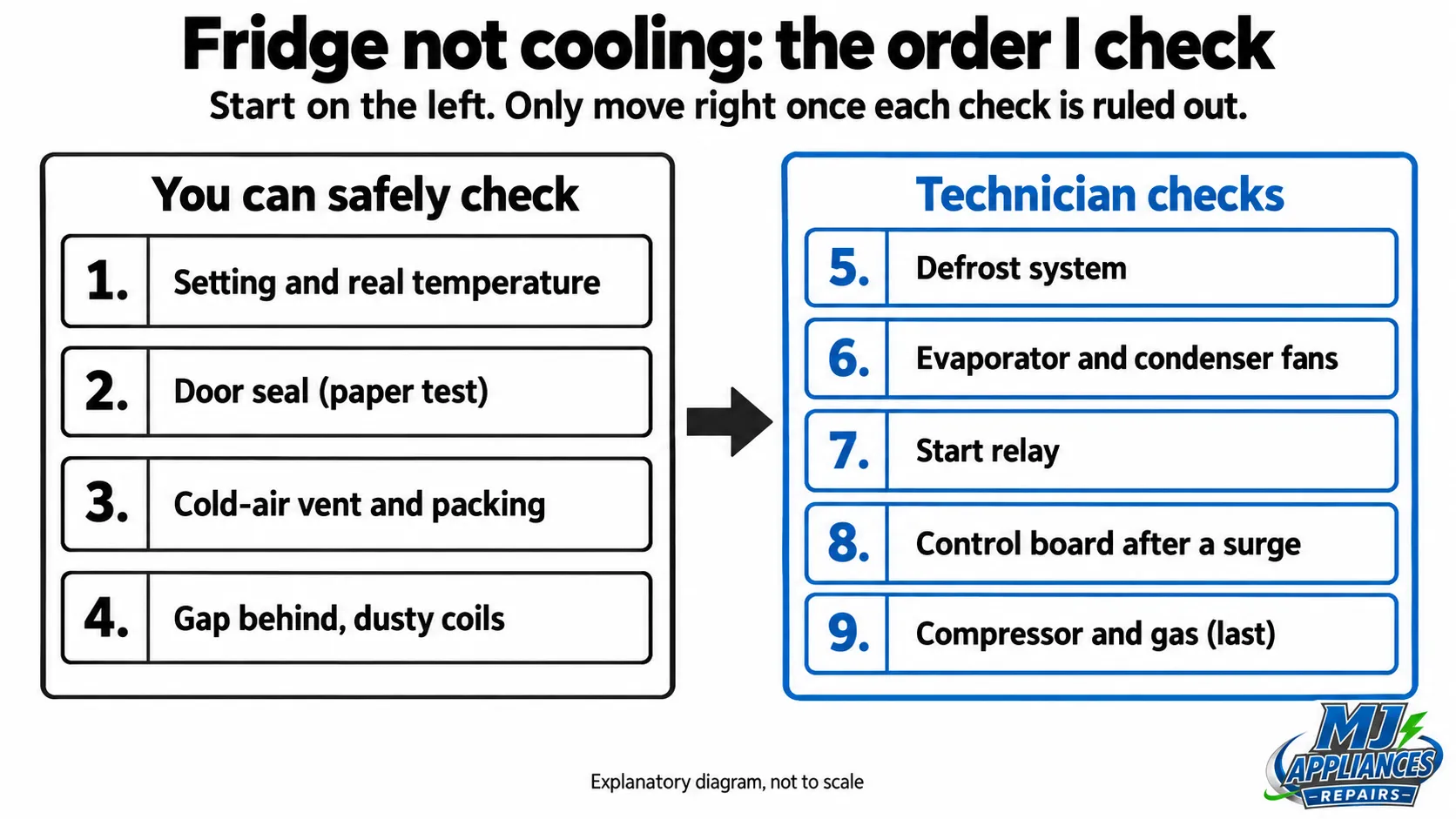
When a fridge stops cooling, start with the simple causes: a knocked thermostat, a door seal that is not gripping, food blocking the cold-air vent, or dusty condenser coils with no gap behind the fridge. If those are fine, look at the freezer. A frozen freezer with a warm fridge points to the fan or defrost system, while both compartments warm points to the start relay, the control board or, least often, the compressor or gas. A regas is rarely the first answer.
When a fridge stops cooling, most people assume the worst. They picture a dead compressor and a new fridge. In my experience that is rarely where it ends. Most fridges I am called out to have a fault that is simple or cheap, and some have no real fault at all.
This is the order I check things in when I arrive at a job. The first half is stuff you can check yourself tonight. The second half is where I take over, and I will explain why.
What the freezer tells you in the first minute
Before I touch anything, I open the freezer. It tells me more than any other check.
If the freezer is frozen solid but the fridge section is warm, the cooling system itself is working. The problem is in the path that carries cold air from the freezer into the fridge, usually a fan or the defrost system. I have written a full guide to the fridge warm, freezer working fault because it is so common.
If both the fridge and the freezer are warm, the cold is not being made at all. That points to the parts that run the cooling: the start relay, the control board, or the compressor and gas.
If both are cold, just not cold enough, start with the simple checks below. That is where most of these turn out to live.
Is the fridge actually set and reading right?
I find a knocked dial more often than you would think. Someone cleans the shelves, the thermostat gets bumped, and the fridge slowly drifts warm. On most dial thermostats a higher number means colder, which catches a lot of people out. On fridges with a digital display, a power cut can sometimes reset the setting or leave a warning showing.
Do not trust your hand to judge the temperature. Put a glass of water with a thermometer in the middle shelf and leave it for a few hours. A fridge should sit around 3 to 5 degrees, and a freezer around minus 18. If the water reads 6 or 7 degrees, the fridge is slightly warm, not broken. If it reads 12 or more, something is genuinely wrong.
Is the door seal gripping?
A tired door seal lets warm kitchen air in all day. The fridge runs harder and never quite gets cold.
Close the door on a sheet of paper and pull it out. If it slides out with no resistance, the seal is not gripping at that spot. Do this all the way round the door, and pay attention to the bottom corner on the hinge side, which is where I usually find the gap. A seal that is just dirty can be cleaned with warm soapy water and it often grips again. A torn, hard or flattened seal needs replacing and fitting properly.
Is cold air able to move?
Cold air comes into the fridge section through a vent, usually at the top or upper back. Pack food tight against it, or push a big pot of leftovers right up to the back wall, and you starve the fridge of cold air. Leave space around the vent and do not overpack the shelves. Let hot food cool before it goes in.
The air around the outside of the fridge matters just as much. A fridge gets rid of heat through the condenser coils at the back or underneath. Push it flat against a wall, box it into a cupboard, or let the coils clog with dust and pet hair, and it cannot shed heat. It runs constantly and never gets properly cold. I see this a lot with built-in fridges in estate kitchens that were fitted with no ventilation gap, and with garage fridges in a Highveld summer.
The safe checks you can do yourself
- Switch the fridge off at the wall and pull the plug before you move it or touch anything behind or under it.
- Pull the fridge out from the wall gently, and check the manual for the gap it needs at the back and sides. If you have lost the manual, a hand's width at the back is a good starting point.
- Find the condenser coils. On most fridges they are on the back, or underneath behind a clip-off grille at the bottom front.
- Vacuum the coils with a soft brush attachment until the dust and fluff are gone. Do not remove any panel that needs a screwdriver to open the electrics.
- Clean the door seal with warm soapy water and dry it.
- Clear the vent inside the fridge section so nothing is pressed against it.
- Plug the fridge back in and switch on, then give it a full 24 hours before you judge it. Check again with the glass of water.
If the temperature comes right after this, the fridge was just struggling. If nothing changes, the fault is inside the system.
Where it becomes technician work
From here on I am working on electrical parts, fans behind panels, and the sealed cooling system. This is where you stop, but knowing the likely fault helps you describe it when you call.
The defrost system
Your fridge melts frost off its cooling coils several times a day. When the defrost heater or its sensor fails, ice builds over the coils and blocks the airflow. On a Defy this is a common culprit. The tell is a fridge that slowly warms over a week or so while the freezer stays cold.
The fans
Frost-free fridges use a fan behind the freezer panel to push cold air around. Many also have a second fan at the back near the compressor that cools the condenser. If either stops, the cooling suffers. Open the freezer and listen for a soft whir. If it is silent while the compressor is running, the fan is high on my list.
The start relay
The relay is the small part that gets the compressor going. When it fails, you often hear a click, a short hum, and then another click a few minutes later, over and over, while nothing gets cold. The relay is one of the cheaper parts on a fridge. Ignore it, though, and the compressor keeps straining to start, which is how a small repair turns into a big one. If you hear that clicking pattern, switch the fridge off at the wall and get it looked at.
The control board after a power surge
Fridges with electronic controls, common on Samsung and LG, can have their control board damaged by a surge when the power comes back after an outage. The fridge might be completely dead, show a strange display, or run without cooling. That needs testing, not guessing. A surge protection plug on the fridge is cheap protection against most of this.
The compressor and the gas
I check these last because they fail least often, and they are the most expensive repairs on a fridge. One thing worth knowing: a fridge does not use up its gas. It runs in a sealed loop. If the gas is low, there is a leak somewhere, and a regas without finding and fixing that leak only buys time. If someone tells you your fridge needs a regas, ask them how they confirmed it. Very often a fan, relay or defrost fault has been mistaken for a gas problem.
When to stop and call a technician
Call someone once you have done the safe checks above, waited 24 hours, and the fridge is still warm. Call sooner if both the fridge and freezer are warm, if you hear the click and hum pattern, if ice keeps coming back over the freezer back panel, or if it went wrong right after the power came back. If you smell burning or the fridge keeps tripping the plug, switch it off at the wall and leave it off until it has been checked.
I open a fridge to find the actual fault, not to sell the most expensive fix, and on most of these the actual fault is a reasonable repair. The call-out covers a proper on-site diagnosis and a full quote before any work starts. If you go ahead with the repair, the call-out comes off the total. You can see how I work on my fridge repair page, everything else I fix is on the services page, and you can book through the contact page.
Send me your fridge fault
If your fridge is not cooling, message me on WhatsApp at 082 419 4125. Tell me the brand and model, whether the freezer is still frozen, whether you can hear clicking, and whether it started after a power cut. Those answers tell me most of what I need before I arrive.