Repair or Replace Your Washing Machine? An Honest Guide for South Africa
By Mluleki Ndlovu · 3 July 2026
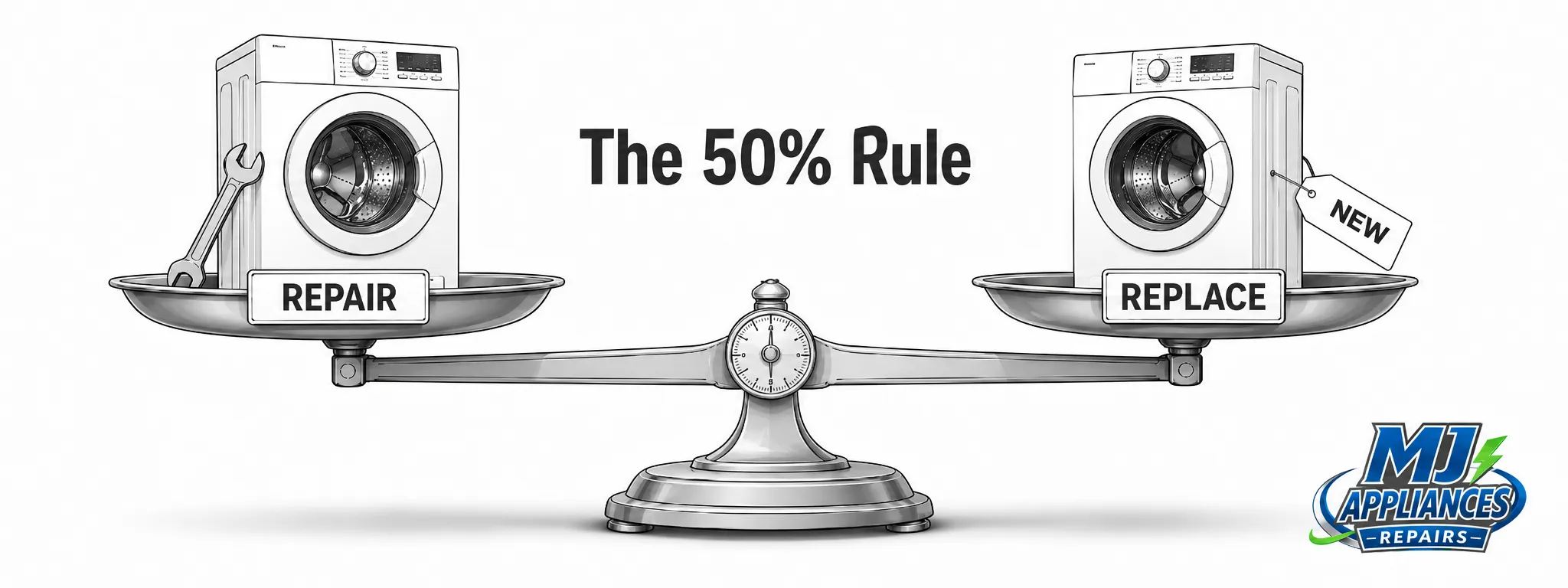
The simplest way to decide whether to repair or replace a washing machine is the 50% rule: if the repair costs more than half the price of a similar new machine, replacing usually makes more sense. Age matters too — most washing machines last about 10 to 15 years, so a machine under 8 years old with a minor fault is almost always worth repairing, while one over 10 years old facing a major part replacement (motor, drum bearings, control board) is often not. In South Africa, a few extra things tip the scales: a new entry-level machine starts at around R5,000, parts for older or discontinued models can be hard to find, and repeated power surges can damage control boards. The honest test is repair cost versus new-machine cost, the machine's age, and whether this is the first fault or the third this year.
At some point most washing machines reach the moment where you have to ask the hard question: is this worth fixing, or is it time to let it go? It's a fair question, and an honest answer can save you a lot of money — in both directions.
I'm Mluleki, and I repair washing machines in Midrand and the areas around it. You might expect a repair man to tell you everything is worth repairing. I won't. Part of doing this job properly is telling someone when a machine isn't worth my time or their money — and when a straightforward repair will give them years more use. This guide walks you through how I think about it, so you can make the call with clear eyes.
Start with the 50% rule
The most useful rule of thumb, used by technicians all over the world, is simple: if the repair will cost more than half the price of a similar new machine, leaning towards replacing usually makes more sense.
So you need two numbers: what the repair costs, and what a comparable new machine costs. A R900 repair on a machine you'd replace for R6,000 is an easy yes — that's 15% of the replacement cost, fix it. A R3,500 repair on that same R6,000 machine is a different story — now you're spending well over half the cost of new, on a machine that's already aging.
To put the replacement side in real terms, in 2025 a new entry-level front-loader in South Africa starts at around R5,000, with mid-range Samsung, LG, Bosch and Defy models sitting roughly between R8,000 and R10,000. Knowing the price of the machine you'd actually buy is what makes the 50% rule work — so it's worth a quick look online before you decide.
Then check the age
The 50% rule gets sharper when you factor in how old the machine is. Most washing machines are built to last around 10 to 15 years, with top-loaders often lasting a little longer than front-loaders.
Here's how I'd think about it by age:
Under 8 years old. Almost always worth repairing, as long as the part is available and the fault isn't catastrophic. A machine this age has plenty of life left, and a single fault is usually just a worn part, not the machine falling apart.
8 to 12 years old. This is the grey zone, and where the 50% rule earns its keep. A minor repair? Still worth it. A major one — motor, drum bearings, control board — and you need to weigh it carefully against the cost of new.
Over 12 years old. A major fault on a machine this age is usually the beginning of the end, not an isolated problem. Once one major part goes, others tend to follow. Unless it's a high-end machine that originally cost a lot, replacement is often the smarter money.
The "third fault this year" test
Age and cost aren't the whole picture. The other thing I watch for is how often the machine has been breaking down.
If this is the first real fault in years, repair it — one problem on an otherwise reliable machine is just normal wear. But if you've already had it fixed once or twice in the last year and here's another fault, that's a different signal. The individual repairs might each seem reasonable, but they add up fast, and they're usually telling you the machine is in general decline. At that point you're not fixing a problem, you're delaying a replacement — and paying for the privilege.
Which faults are usually worth fixing
Some repairs are almost always worth doing, because the parts are affordable and they don't mean the machine is failing:
- A blocked or faulty drain pump
- A worn door seal or gasket on a front-loader
- A broken door latch or lid switch
- Worn drive belt
- A blocked filter or drainage fault (often a cheap or even free fix — I've written a separate guide on diagnosing a machine that won't drain)
- Worn shock absorbers causing excessive vibration
These are the bread-and-butter repairs. On a machine that's otherwise in good shape, they're worth doing without much hesitation.
Which faults often mean it's time to let go
Other faults are expensive enough that, on an older machine, they push you towards replacement:
- A failed motor
- Worn drum bearings (often the cause of a loud grinding or rumbling on spin — the repair is labour-heavy)
- A cracked or damaged drum or tub
- A failed control board, especially if parts are scarce
None of these are automatically a death sentence — on a newer or high-end machine, even a major repair can be worth it. But on a machine past 10 years, any one of them is usually where I'd tell you honestly that your money is better spent on a new machine.
The South African things that tip the scales
A few local realities matter here, and they're worth being honest about.
Parts availability. This is a big one. Defy is South Africa's most common brand, and parts are generally easy to get — that counts in favour of repairing a Defy. But for older models, discontinued ranges, or less common imported brands, parts can be hard to find or slow to arrive. If a part has to be ordered in and the wait is long, that changes the picture, even for a fault that would otherwise be worth fixing.
Power surges. South Africa's grid has been more stable recently, but power surges remain a real risk — and the moment power is restored after any outage is when the damaging spike happens. Those surges are hard on the sensitive control boards in modern machines. If a machine has had its control board damaged by a surge and it's an older unit, the cost of that board can easily tip it past the 50% line. A surge protector on the plug is cheap insurance worth considering whatever you decide.
Hard water. In some areas, hard water and scale build-up shorten the life of heating elements and other parts. It doesn't change the repair-or-replace maths on its own, but it's part of why a machine might be wearing out faster than its age suggests.
How I help you decide
When I come out, the call-out fee covers a proper diagnosis and a clear quote. That quote is exactly what you need to run the 50% rule for yourself — you'll know what's wrong, what the repair costs, and how that compares to a new machine. I'll give you my honest view, including when I think replacing is the better call. I'd rather you trust me with the next repair than oversell you on this one.
When to call a technician
It's worth getting a professional diagnosis before you decide, especially if:
- You've got a repair quote and need help weighing it against a new machine
- The machine is making loud grinding or rumbling noises on spin (possible bearings)
- There's a burnt smell, scorched wiring, or a control-board fault after a power surge
- The machine is leaking from underneath, or the drum isn't spinning properly
- You're getting repeated faults and aren't sure if the machine is worth keeping
I do washing machine repairs across Midrand and the surrounding areas, all brands, with a workmanship guarantee on the repair. If you'd like an honest diagnosis and a clear quote to help you decide, send me a message on WhatsApp at 082 419 4125 with the machine's make, rough age, and what it's doing. You can also see what I cover on the services page or get hold of me on the contact page.
A broken machine doesn't always mean buying a new one — and sometimes it does. The honest answer is the one that leaves you better off.
If you're weighing this decision up locally, I run a Midrand appliance repair service — and as I said above, the honest answer is the one that leaves you better off.