Can Load Shedding Damage Your Washing Machine? What Actually Breaks and How to Protect It
By Mluleki Ndlovu · 23 July 2026
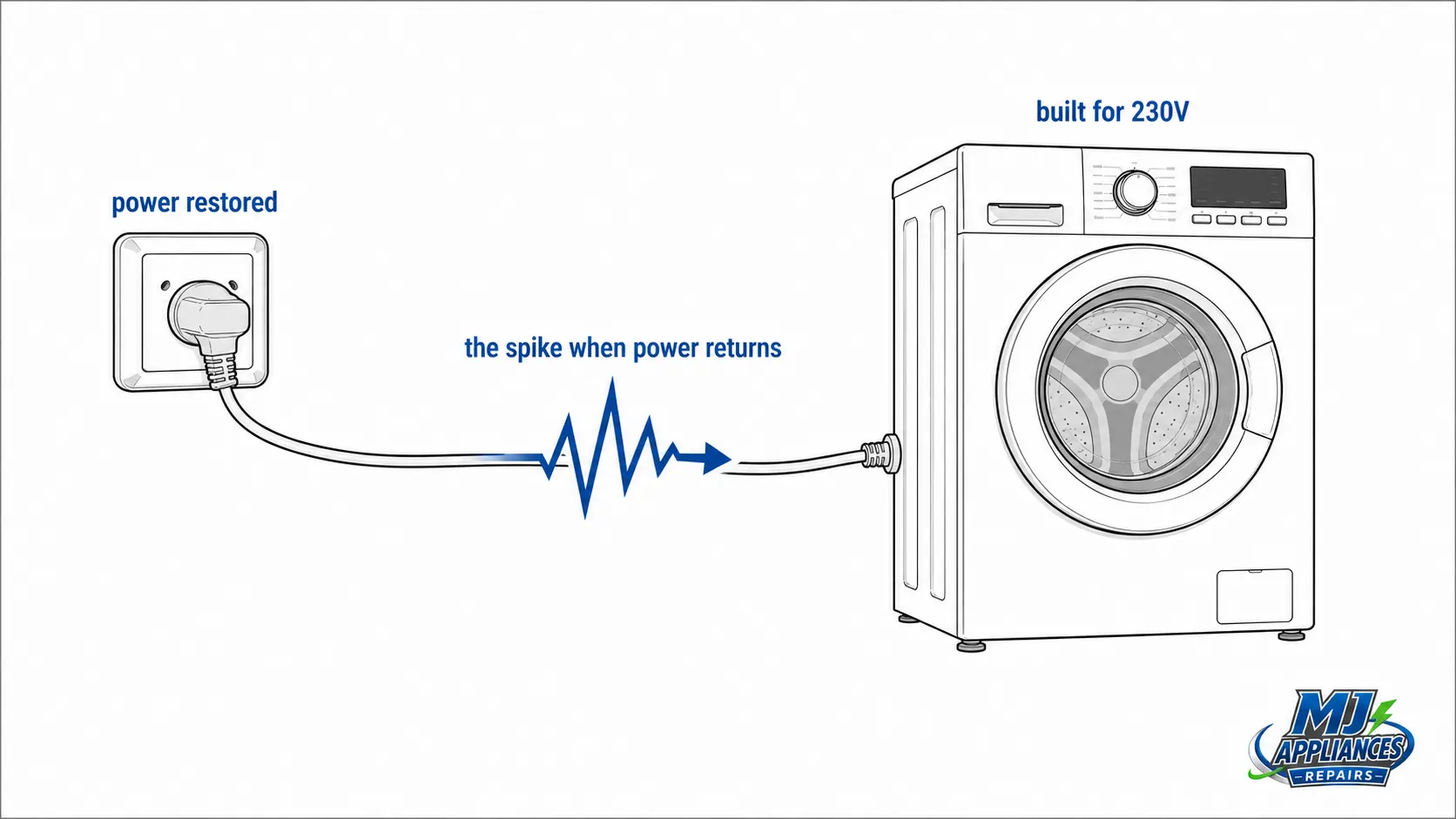
Yes — but the danger was never the power going off. It is the voltage spike when electricity comes back, which can hit a machine built for 230 volts with several thousand volts and damage the control board. Even with load shedding suspended, the same risk comes from load reduction cuts, cable faults and storm outages. The cheapest protection is switching the machine off at the wall during any outage and waiting a few minutes after power returns before switching it back on.
For years, the first call I got after a bad week of load shedding was always the same one: "The power came back, and now the washing machine is dead." Load shedding stopped over a year ago, but I still see the same damage on call-outs around Midrand. Why? Because it was never the power going off that broke the machines. It is what happens when the power comes back.
Load shedding is suspended — so why does this still matter?
South Africa has now gone more than a year without load shedding, and Eskom says this winter should be stable too. That is good news. But your washing machine was never in danger because of a schedule. It is in danger every time the power goes off and comes back on — for any reason.
And the power still goes off. Some suburbs are on load reduction, where Eskom cuts power in the morning and evening because the local network is overloaded. Storms knock out lines. Cables fail. Substations trip. If your lights ever go out, this post is for you. And if load shedding ever comes back, your machine will already be safe.
The real damage happens when the power comes back
Here is the part most people do not know. When the power comes back on, it does not come back smoothly. For a split second, the line can carry a spike of several thousand volts. Your washing machine is built for 230 volts. That spike is the danger.
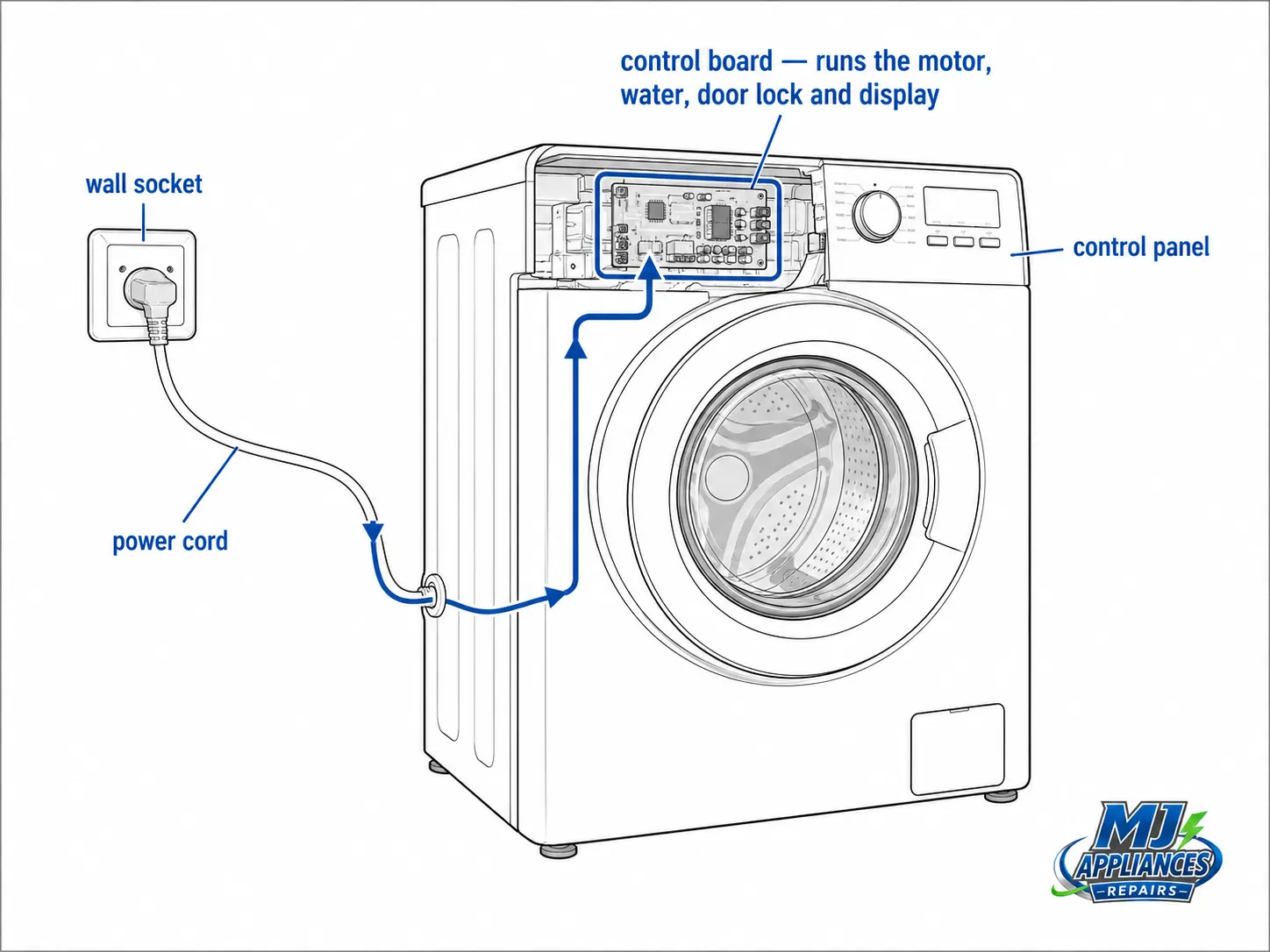
A modern washing machine is basically a computer that washes clothes. Behind the control panel sits a small electronic board — the control board — that runs everything: the motor, the water, the door lock, the display. It is the most sensitive part of the machine, and it is the part the spike hits. Sometimes the board dies right away. More often, it gets a little weaker every time the power cuts and returns, until one day the machine simply will not switch on — on a day when the power was fine.
A power cut in the middle of a wash causes its own trouble too. The cycle gets confused, the door stays locked, and a drum full of water just sits there until the power returns. If you have ever come home to a machine that will not give your washing back, that is what happened — and if the water will not drain afterwards, my guide on a washing machine that will not drain walks you through the checks.
How to check your machine safely after an outage
If the power went off and came back, and the machine is now acting strange, work through this before you call anyone.
- Unplug the machine at the wall before you touch or check anything.
- Wait for the power to settle. Give it a few minutes after the lights come back before you plug anything in. The first moments of returning power carry the spike.
- Check the plug and the wall socket. Look for burn marks or dark spots, and smell for burning. If you find either, leave the machine unplugged and stop here.
- Plug back in and try a reset. Switch the machine on. Many machines come right after a mid-cycle cut with nothing more than being switched off at the wall and on again.
- Watch the first cycle. Run a short programme with the machine empty. Watch for error codes, strange noises, or the machine cutting out.
If the machine trips your electricity the moment you plug it in, or the display stays dead at a socket you know is working, do not keep trying. That is electrical damage, and it is technician territory.
How to protect your washing machine from surges
The good news: most of the protection costs little or nothing.
- Switch the machine off at the wall when the power goes out. Especially mid-cycle. A machine that is switched off cannot be hit by the return spike.
- Wait a few minutes after the power returns before switching it back on. Let the spike pass first.
- Use a proper surge protector plug. An ordinary cheap multiplug is not a surge protector. A real one is made for the job — it must say Surge Protected on the unit.
- Ask an electrician about surge protection on your distribution board. This protects the whole house, not just one appliance. It involves your DB board and mains wiring, so it is a job for a professional — never DIY.
- Do not start a wash just before a known cut. If your suburb is on load reduction, do not put a load on shortly before the morning or evening window.
Will insurance cover surge damage?
During the heavy load shedding years, so many people claimed for surge damage that insurers changed the rules. Surge cover for appliances usually sits under your household contents insurance, often with its own limit. Some insurers now charge an extra excess on surge claims, or will not pay at all unless you have surge protection fitted on your DB board. I am a technician, not a broker, so I will only say this: read your policy, find the power surge section, and check what it asks of you. Better to find out now than after a claim is turned down.
When to stop and call a technician
Surge damage lives in the parts of the machine you should never open — the control board, the motor, the wiring inside. If the machine is dead after an outage, trips your electricity, smells of burning, or shows error codes that a reset will not clear, it needs a technician with a metre and the panel off.
And here is the honest part: a damaged control board on an older machine is one of those faults where fixing is not always the right answer. Boards are among the pricier parts, and on an older machine the maths changes. My guide on whether to repair or replace your washing machine gives you the honest numbers before you decide either way.
I handle washing machine repairs across Midrand and greater Johannesburg — I come to you, check the machine at your home, and give you a full quote before any work starts. You can see how the call-out works on the services page or book directly here.
If your machine has not been right since the power last went off, send me a WhatsApp on 082 419 4125 and tell me what happened and what the machine is doing now. A clear description means I arrive knowing what to look for.