Washing Machine Not Filling With Water? What I Check, In Order
By Mluleki Ndlovu · 8 November 2026
When a washing machine will not fill with water, the cause is usually outside the machine: a tap that is closed or failing inside, a kinked inlet hose, low water pressure, a door that has not latched, or a blocked mesh filter where the hose screws onto the machine. Check those first with the machine unplugged and the tap closed. If water reaches the machine with good pressure and it still will not fill, the fault is usually the inlet valve, the pressure switch, the door lock or the control board, which is technician work. If water runs in but the drum never fills, the drain hose is siphoning it straight out.
You press start, the machine clicks or hums, and the drum stays empty. Most people I speak to have already decided the machine is finished. Often it isn't. A good share of the not-filling calls I get turn out to be the water supply, not the washing machine, and most of that you can check yourself before you spend anything.
What exactly is your machine doing?
"Not filling" covers four different faults, and the first job is working out which one you have.
No water and no sound. The machine shows the programme, maybe locks the door, and nothing happens at the back. This is usually the supply: a closed or failing tap, no municipal water, or a door that has not latched.
Humming or clicking, but no water. The machine is asking for water and the valve is trying to open. Either water is not reaching the valve (tap, hose, filter), or the valve itself has failed.
A trickle, then an error code. Water arrives, just too slowly. The machine times out and stops, often with a code. Low pressure or a partly blocked inlet filter is the usual cause.
Water comes in, but the drum never fills. You can hear it running in, yet the level never rises. That water is leaving as fast as it arrives, through the drain hose. I cover that one further down, because the fix is completely different.
The simple causes I rule out first
Before I take a panel off any machine, I check the boring things. They are the most common, and they cost nothing.
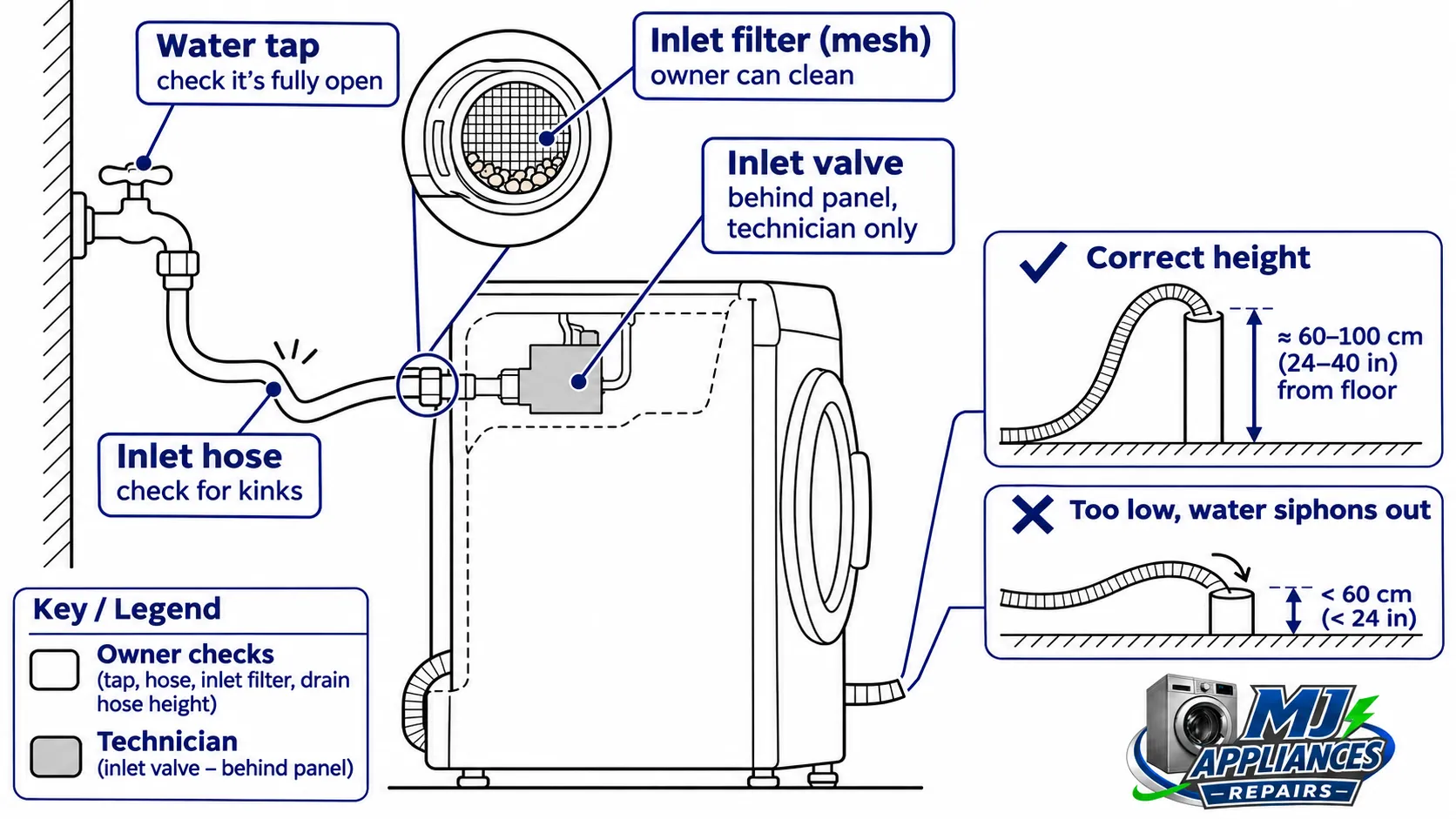
The tap behind the machine is the first. It gets knocked half-closed when someone reaches behind the machine, and older taps can fail inside while the handle still looks open. Then the inlet hose: if the machine has been pushed back against the wall or moved recently, the hose can fold flat behind it.
The door matters too. A front loader will not let water in until the door lock tells the board the door is shut and latched. On a top loader, the lid switch does the same job. A door that looks closed but has not clicked home will stop the fill before it starts.
Finally, check the settings. Delay start, a half-load programme, or a cycle that was paused can all look like a machine that won't fill. And check the water in the rest of the house. If the municipal supply is off or the pressure is very low, the machine is not the problem.
How to check the supply and inlet filter yourself
This is safe owner work, as long as you do it in this order. Keep an old towel and a bucket nearby.
- Switch the machine off at the wall and unplug it, then close the water tap behind it. Never work on the hoses while the machine is plugged in.
- Open a tap elsewhere in the house. If the water there is weak or off, wait for the supply to return before you go any further.
- Unscrew the inlet hose where it joins the back of the machine. Have the towel ready, because a little water will come out.
- Point the free end of the hose into the bucket and open the tap for a moment. A strong, steady flow means water is reaching the machine. A weak flow means the problem is the tap or the plumbing, not the washing machine. Close the tap again.
- Look inside the inlet on the back of the machine for the small mesh filter. If it is packed with grit or sand, pull it out gently with flat-nosed pliers and rinse it under a tap. Do not force it or poke anything through the mesh.
- Refit the filter, screw the hose back on firmly by hand, and open the tap. Check the connection for drips, plug the machine in, and run a short rinse.
If your hose has a plastic safety box at the tap end, which many Bosch and Siemens machines have, leave that box closed. It contains its own valve and is not something to open.
Why inlet filters clog around Midrand
That little mesh filter is there to stop sand and grit reaching the valve. In some homes it fills up faster than you would expect.
In the estates on borehole water, Blue Hills and Kyalami especially, I find fine sand packed into the inlet filter, and sometimes right inside the inlet valve. Borehole water carries sediment that municipal water mostly does not, and the washing machine is often the first appliance to show it.
Municipal outages do something similar. When the water comes back after a cut, the first rush through the pipes carries loose grit and air. If the washing machine is the first thing to draw water, that grit goes straight into the filter. When the supply returns after an outage, I suggest running a tap for a short while before you start a wash.
Water comes in but the drum never fills
If you can hear water running in but the level never rises, the water is siphoning straight out through the drain hose. It can waste a lot of water before the machine gives up with an error.
The usual cause is the drain hose sitting too low, or pushed too far down into the standpipe. Water then runs out under gravity as fast as it comes in. I see this most after a machine has been moved or installed without following the manufacturer's height guide for the drain hose. Your machine's manual gives the correct height for your model.
With the machine off and unplugged, check where the drain hose ends. If it lies on the floor, or hangs down into a drain lower than the machine's guide allows, that is your likely fault. If your machine also struggles to empty, the drain side may be blocked as well, and I go through that in why a washing machine won't drain.
When it is the machine itself
If water reaches the machine with good pressure, the filter is clean, the door is latched, and it still will not fill, the fault is inside the machine. These are the parts I test next.
The inlet valve is an electrically operated valve at the back. When its coil fails, you often hear a hum with no water. When sand has got past the filter, the valve can stick partly open or shut. The pressure switch, or water level sensor, tells the board how much water is in the drum. If it reads wrongly, the machine can believe it is already full. The door lock can fail electrically even when the door shuts properly. And the control board can stop sending power to the valve, which I see after power surges and outages.
All four sit behind the panels, next to mains wiring and water. That is technician territory. Testing them safely needs a meter and the machine opened up, and a wrong move can turn a valve fault into a board fault.
Many machines show this fault as a code. On older Defy top loaders it is E1, on Samsung it is 4C, and on LG it is IE. If you have a Defy, my Defy error code guide explains what each code means for your model. And if your machine fills fine but stops before the spin, that is a different fault: I go through it in the six faults I check when a washing machine won't spin.
When to stop and call a technician
Call a technician if the supply checks out and the filter is clean but the machine still won't fill. Call if it hums with no water, if the same fill error keeps returning, or if water enters and the drum still never fills after you have corrected the drain hose. Stop straight away if you notice water inside the machine's base or a burning smell.
When I come out, I test the supply at the machine first, then the valve, the pressure switch, the door lock and the board, in that order. You get the diagnosis and a full quote before any work starts, and the R800 call-out is deducted from the repair if you go ahead. If the part is on hand, I fix it the same visit where possible. If a part has to be ordered, I tell you the lead time before anything is done.
I repair washing machines across Midrand, Centurion and Thatchfield, at your home. You can read how I handle washing machine repairs, see everything I do on the services page, or book a visit.
If your machine won't fill, send me a WhatsApp on 082 419 4125 and tell me what it is doing: silent, humming, trickling, or filling and running out. That one detail tells me a lot before I arrive.